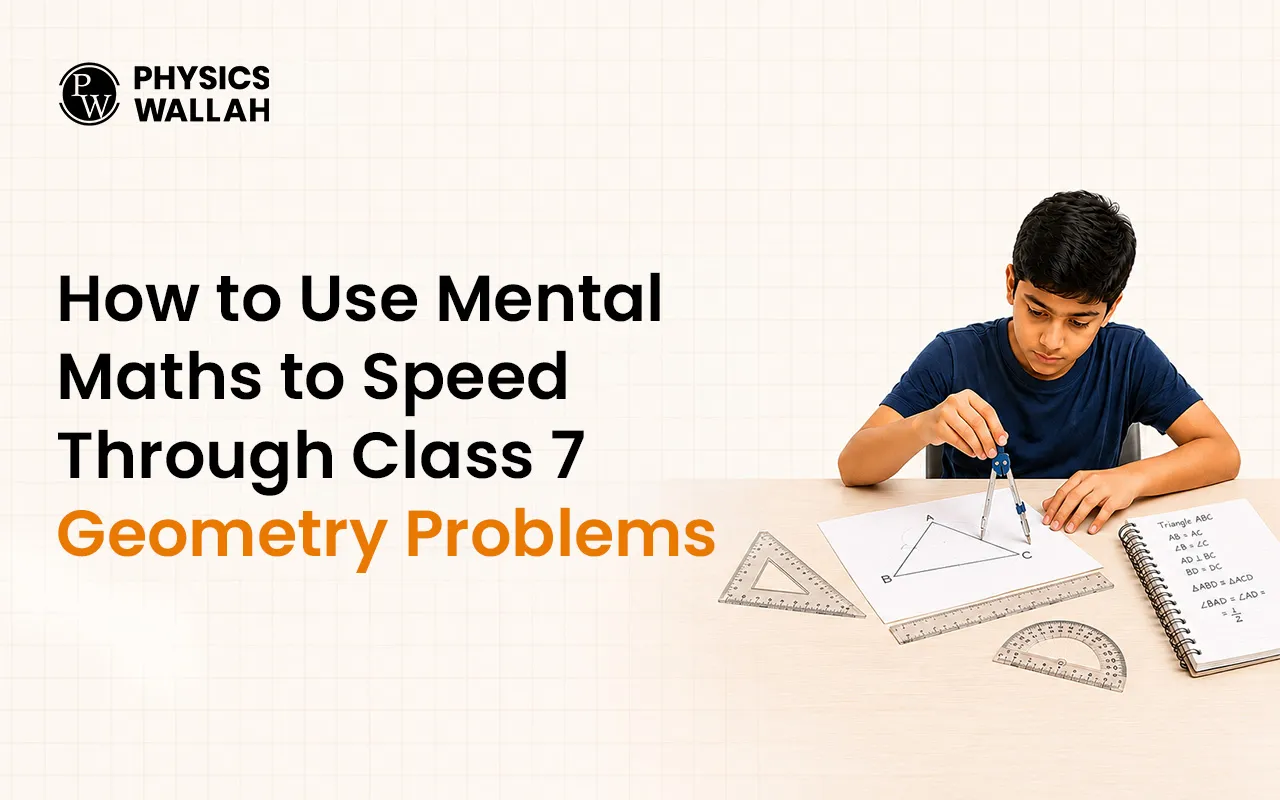
How to Use Mental Maths to Speed Through Class 7 Geometry Problems
 Nikita Aggarwal26 Jun, 2026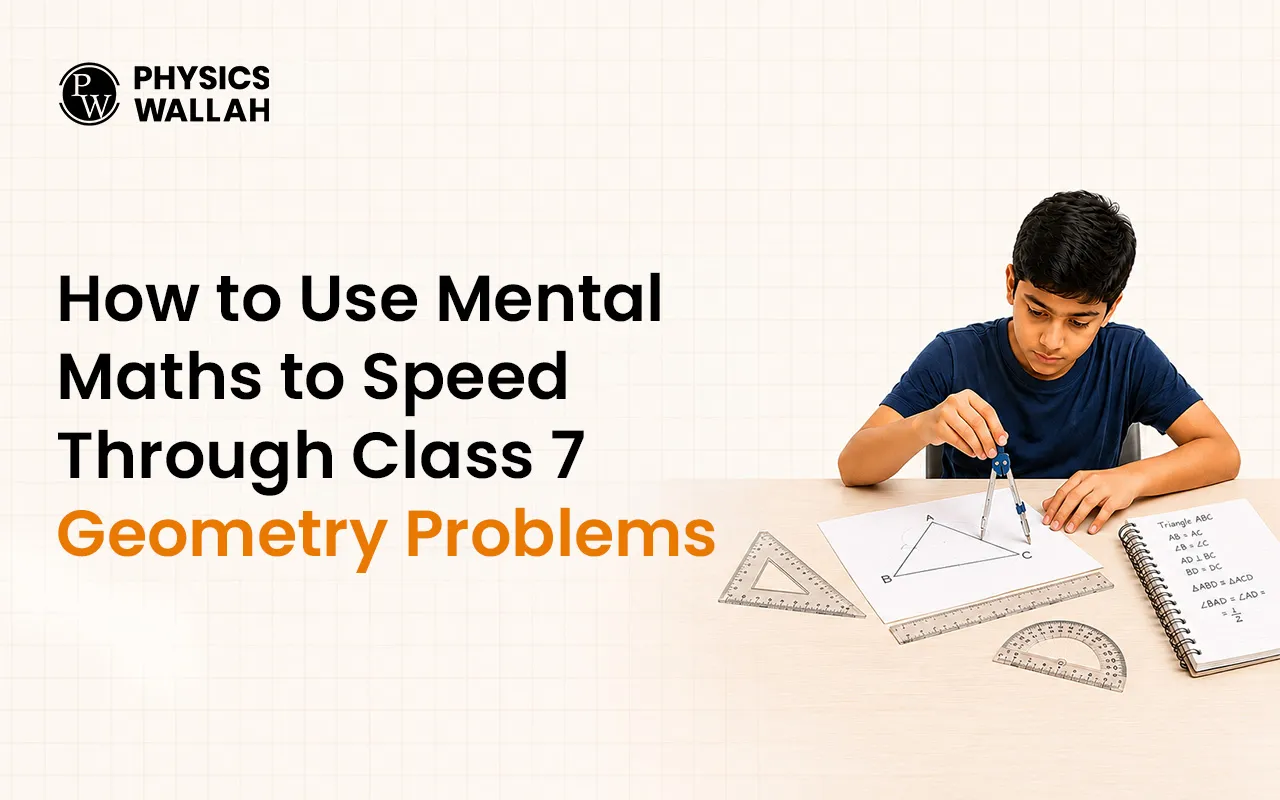
Benefits of Mental Maths for Class 7 Geometry
Using mental maths for geometry is not just about calculating numbers quickly in your head. It changes how you understand spatial properties and mathematical dimensions. When you do not rely entirely on a pen and paper, you look at shapes as complete structures rather than isolated lines.
The table below shows a comparison between the traditional pen and paper methods in geometry and the application of strategies in mental Mathematics for your daily school practice sessions.
|
Geometry Skill Area |
Traditional Written Method |
Mental Maths Approach |
|
Finding Unknown Angles |
Writing equations like $x + 55 = 180$ |
Subtracting the angle from 90 or 180 instantly |
|
Checking Triangles |
Using a ruler to write down all three sides |
Mentally applying the triangle inequality rule |
|
Solving Worksheets |
Takes 4 to 5 minutes per diagram |
Completed in under 60 seconds visually |
Developing these skills alters your workflow. Instead of getting stuck in long calculation steps, you focus your mental energy on understanding complex exam theorems. This visual agility is exactly what helps top students score high marks without running out of time.
Mental Maths for Class 7 Geometry Angle Questions
The foundation involves lines and angles. If you can calculate unknown angles without writing down every subtraction step, you save massive amounts of time. You only need to learn how to use a few baseline numbers like 90, 180, and 360 as your mental anchor points.
Here is a quick reference list of the core angle pairs you will see in your Class 7 textbook diagrams:
-
Complementary Angles: Two angles that add up to exactly 90 degrees.
-
Supplementary Angles: Two angles that form a straight line and add up to 180 degrees.
-
Linear Pairs: Adjacent angles on a straight line that always sum to 180 degrees.
-
Vertically Opposite Angles: Equal angles formed opposite each other when two lines intersect.
To apply mental maths for Class 7 geometry here, use the "subtraction from left to right" method. If you see a linear pair where one angle is 65 degrees, do not write a long equation. Mentally break down 180 into 100 and 80. Subtract 60 from 80 to get 20, then subtract 5 to get 15. Combine that with the remaining 100 to find your answer: 115 degrees.
How to Solve Triangle Questions in Class 7 Geometry
Triangles are a major part of the syllabus. Students often spend too much time using the angle sum property on paper. You can speed through these regular problems by using simple mental shortcuts instead.
The following list highlights the primary triangle laws you can calculate mentally to save time during tests:
-
Angle Sum Shortcut: The three interior angles of any triangle always add up to 180 degrees.
-
Exterior Angle Property: The exterior angle equals the sum of the two interior opposite angles.
-
Isosceles Triangle Rule: Angles opposite to equal sides are always equal to each other.
If an exam problem shows a triangle with two known angles of 50 degrees and 70 degrees, you can add them mentally to get 120 degrees. Then, subtract 120 from 180 to find the third angle, which is 60 degrees. This entire process takes less than three seconds when practiced regularly.
For exterior angles, bypass the interior angle calculation entirely. If a question asks for an exterior angle and gives you the two opposite interior angles as 45 degrees and 65 degrees, simply add them together. Your brain instantly computes 45 plus 65 to get 110 degrees, giving you the final answer directly.
Read More - Mental Division Tricks for Class 7
Visual Exercises to Improve Mental Maths for Class 7 Geometry
To get fast at mental maths for geometry, you need to practice regular mental imagery. This means looking at a geometric diagram and moving the pieces around inside your mind before you write anything down.
Try these three simple mental exercises during your daily study sessions to build your visual speed:
-
The Grid Mirror: Imagine a simple shape like a right-angled triangle on a grid, then mentally flip it upside down to see if the angles change.
-
The Line Extender: When looking at intersecting lines, mentally extend the straight lines out to see the vertically opposite angles clearly.
-
The Shape Deconstructor: Mentally slice complex polygons into smaller triangles to calculate their total internal angles quickly.
Using these internal visualization exercises stops you from feeling confused by cluttered diagrams. It helps you see the hidden lines that reveal the easiest calculation path.
Common Mistakes to Avoid in Mental Maths for Class 7 Geometry
Using Class 7 geometry speed tricks saves time, but moving too fast can lead to careless calculation mistakes. The most common error occurs when students mistake complementary angles for supplementary angles during fast calculations.
To keep your fast work accurate, follow these practical steps during your revision sessions:
-
Check the Base Numbers: Always confirm if the problem requires subtraction from 90, 180, or 360 degrees.
-
Verify with Estimation: Look at the diagram to see if the angle is acute or obtuse to ensure your mental answer makes sense.
-
Use Visual Balances: If one angle in a linear pair is large, your calculated missing angle must be small.
By keeping these quick verification checks in your head, you ensure your Class 7 maths mental shortcuts remain completely accurate during high-pressure school exams.
Symmetry Shortcuts and Tips in Mental Maths for Class 7 Geometry
Symmetry is another excellent area for applying mental maths geometry Class 7 rules. Instead of drawing lines of symmetry with a plastic ruler, you can find the answers by using mental rotation and reflection tricks.
The list below outlines how to mentally determine the symmetry of standard geometric shapes:
-
Equilateral Triangles: Possess three distinct lines of symmetry and rotational symmetry of order three.
-
Regular Squares: Have four lines of symmetry and rotational symmetry of order four.
-
Regular Hexagons: Feature six lines of symmetry and rotational symmetry of order six.
Recognizing these patterns helps you answer symmetry questions instantly. If a question asks for the order of rotational symmetry of a regular polygon, you do not need to draw it out. Simply count the number of equal sides mentally, as that number matches the order of symmetry perfectly.
Read More - Speed Maths Test for Class 7 (Try Now)
Daily Plan for Mental Maths for Class 7 Geometry
Building strong mental processing speeds requires regular, short practice sessions rather than long hours of cramming. Spending just ten minutes a day on targeted mental calculation drills will improve your geometry marks quickly.
The table below provides a structured five-day practice routine to build your mental arithmetic precision.
|
Day of the Week |
Targeted Geometry Focus Area |
Daily Mental Exercise Goal |
|
Monday |
Complementary Angles |
Calculate complements for 20 random numbers under 90 |
|
Tuesday |
Supplementary Lines |
Subtract random double-digit numbers from 180 mentally |
|
Wednesday |
Triangle Interior Sums |
Add two random angles and find the third angle mentally |
|
Thursday |
Parallel Line Rules |
Identify corresponding and alternate angles in mind maps |
|
Friday |
Symmetry and Rotation |
Mentally calculate lines of symmetry for regular shapes |
Following this structured plan keeps your brain sharp. Over time, you will notice that you no longer need to write down basic arithmetic steps when solving complex geometry worksheets at school.
How CuriousJr Improves Mental Maths for Class 7 Geometry
Learning Class 7 angles and shapes requires structured guidance, consistent practice, and interactive learning. While traditional textbooks often rely on static exercises, modern learning resources can help students develop faster calculation and visualization skills. CuriousJr Class 7 Mental Maths Course offers engaging drills, geometry-based activities, and practical problem-solving exercises designed to strengthen mental arithmetic. By regularly practicing Class 7 angles and shapes mental maths, students can improve speed, accuracy, and confidence when tackling geometry questions in school and exams.




How to Use Mental Maths to Speed Through Class 7 Geometry Problems FAQs
How does mental maths for geometry help in school exams?
What are the best Class 7 geometry speed tricks for parallel lines?
Can I use these Class 7 maths mental shortcuts for all shapes?
How do I practice mental maths geometry Class 7 daily?

Get Free Counselling Today
and Clear up all your Doubts
 Live & recorded classes available at easeDashboard for progress trackingLakhs of practice questions